|
|
Justice Sunday
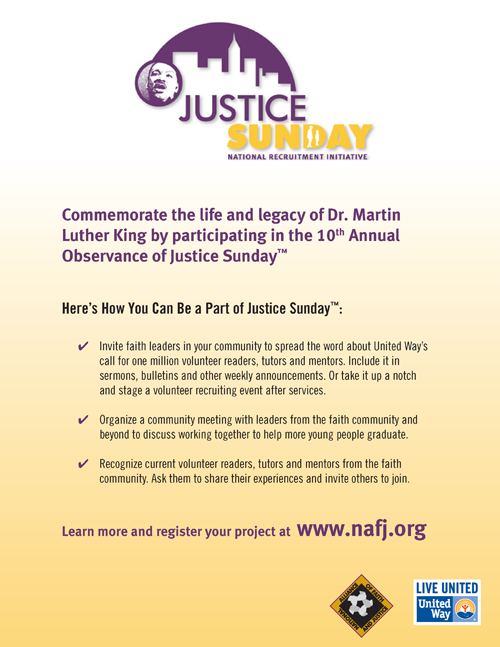
Justice Sunday National Continuum
- The National Alliance of Faith and Justicehas begun plans for the Justice Sunday™ National Continuum which will kick off with the annual observance of Justice Sunday™ on January 20, 2013.
- In cities across the county, this annual event continues to place a priority upon community impact which may be achieved through mentoring by integrating commemoration with national service on the day prior to the federal holiday observed as the Martin Luther King, Jr. Day of Service.
- Justice Sunday™ 2013 serves as a countdown to the 50th anniversary of one of Dr. King's most powerful speeches, "I Have A Dream," delivered August 28, 1963.
- Words echoed in his speech from the steps on the Lincoln Memorial in the symbolic shadow of President Abraham Lincoln also connect January 2013 with Justice Sunday™ priorities by celebrating January 1, 2013, as the 150th anniversary of the Emancipation Proclamation, signed by Mr. Lincoln, and the first day of National Mentoring Month;
- In "I Have A Dream," Dr. King referred to 1963 as a beginning, not an end;
- The annual theme of Justice Sunday™, "A Charge To Keep I Have To Serve This Present Age," invites the nation to honor Dr. King in his vocation as a clergy and the role of faith to service by establishing commitment the day before to serve on and beyond the federal holiday.
- Dr. King spoke of the demands of freedom, the security of justice, and the urgency of now.
- His words underscore the priority signed into Executive Order by President Barrack Obama to enhance educational outcomes for African Americans which will lead to more productive careers, improved economic mobility and security, and greater social well-being for all Americans.
- Towards this goal and unwavering commitment, the continuum will renew priorities of NAFJ and its national partners, the National CARES Mentoring Movement, the Association of Black Psychologists, United Way Worldwide, our affiliates/circles and like-minded citizens across the country to encourage mentoring, reading, and tutoring to support a enhanced educational outcomes, lead to more productive careers, improved economic mobility and security, and greater social well-being for all Americans;
- Justice Sunday™ can become a strategic crossroad and benchmark to organizations and institutions of faith to unite, initiate, and orchestrate a shared vision of change and a goal of realizing one million volunteer mentors, readers, and tutors.
- Justice Sunday™ has been observed by millions since 2000 as a precursor for the MLK Day of Service and was trademarked for priorities herein described by the National Alliance of Faith and Justice in 2005.
^ Return to Top
Justice and Sunday
- Both the term "justice" and "Sunday" are deeply seeded in faith, service, the protection and furtherance of human and civil rights.
- In a message delivered by Dr. King, he once cited his disappointment with attitudes of segregation which traditionally occurred in worship environments nationwide at 11am on Sunday;
- Today at this timeframe or other standard worship hours, Justice Sunday™ can become a benchmark for unity and action.
- It was from pulpits that the charge was often sounded during the civil rights movement to empower the brigades of volunteers and foot soldiers of justice.
- Leaders of faith often stood on the front lines of bitter and dangerous sacrifice for justice, and was with colleagues of faith and justice that Dr. King discussed mobilization strategies;
- It was volunteers of faith and community who stood with leaders and persons concerned about equality to transcend denominational, gender, strong political, social, racial, economic, generational, and so many other divides for the cause of justice and "needle-moving" change.
- It was Dr. Martin Luther King, a husband and father, supported by his wife, Mrs. Coretta Scott King, who by faith rose to become the powerful voice and a drum major for justice.
- Though faith traditions may vary and Sabbath is also observed as a primary day of worship, Sunday marks a day on which congregations of diverse backgrounds gather in fellowship, renewal, thanks, and are inspired to serve.
^ Return to Top
Variables Which Support the Specified Week
- America has a long history of efforts that were groundbreaking and changed the lives of many individuals, helping shape advances and the continued quest for justice today.
- Communities can point to numerous examples of collaborations and innovation created to solve very complex local and national problems.
- The issues of justice for which Dr. King gave his life have improved but continue to require the courage, persistence, innovation, and acknowledgment of volunteers to address unmet and costly needs.
- Mentoring is a valued service to improve the lives of youth in academic performance, life skills, employment and transitional preparation, and many other connections necessary foster equitable access to this nation’s resources.
- Since 2000, NAFJ has designated and encouraged the observance of Justice Sunday™ as a national movement for change through sustained service to honor the late Dr. Martin Luther King, Jr. and his leadership as a clergy along with thousands whose actions during the civil rights movement have translated into a measurable difference in many ways.
- Volunteers help to preserve public safety, fill critical gaps where federal, state, and local resources are not available, and work to engage the rich diversity of American religious communities in partnerships to strengthen the common good in America.
^ Return to Top
How Can You Join In This Initiative?
- Visit our website (www.nafj.org) and SIGN ON;
- Connect Service With A Service:
- Whether on Justice Sunday™, your day of worship, or in conjunction with your commemorative event, host a mentor recruitment;

- As a precursor to Black History Month and in support of the continuum, join with us and our partner, the Association for the Study of African American Life and History (www.asalh.net), in our campaign, "A Dollar Earned: A Lesson Learned" - Donate $1 during Justice Sunday™ mentor recruitment efforts (a schedule of mentor recruitment activities will be posted on our website) or an extension of a commemorative concert, meal, or other event honoring Dr. King to purchase book or bring school supplies to enter.
- LIVE UNITED . . . Use this opportunity to connect with your local United Way to establish cross sector leadership which can make community impact. www.unitedway.org
- Mentors:
- Partner with us, adopt a school, or independently work with students enrolled in one or more low performing schools through structured mentoring and tutorial programs to help them improve their reading or other academic areas. Find out more by visiting the website of the National CARES Mentoring Movement, www.caresmentoring.org
- Become a sponsor or part of the PEN OR PENCIL™ Movement, www.penorpencilmovement.org.
- We need corporate volunteers. Sign up to become a site.
- Financial institutions . . . step forward as mentoring partners for our PEN OR PENCIL™ stock market component. To learn more contact us at specialprojects@nafj.org.
- Recognition:
- Recognize volunteers who serve. Visit the Corporation for National and Community Service at www.cns.gov.
- Use National Mentoring Month to recognize mentors who have served in this capacity;
- Other Ways:
- Enter the Justice Sunday: To Serve This Present Age Service Learning Competition (Details coming soon!!!)
There are many more ways to make this week meaningful. Share your ideas with us at www.volunteer.org
^ Return to Top
More Material Related to Justice Sunday
|